

As a flap disc supplier, I've witnessed firsthand the significant impact that speed settings can have on the performance of flap discs when used with variable - speed grinders. In this blog, we'll delve into the science and practical aspects of how different speed settings affect flap disc performance.
Understanding the Basics of Flap Discs and Variable - Speed Grinders
Flap discs are versatile abrasive tools commonly used in metalworking, woodworking, and other industries. They consist of multiple overlapping abrasive flaps attached to a backing plate. These flaps are designed to wear down gradually, exposing fresh abrasive grains and maintaining a consistent cutting action.
Variable - speed grinders, on the other hand, allow users to adjust the rotational speed of the grinding wheel or flap disc. This flexibility is crucial as different materials and applications require different cutting speeds for optimal results.
The Impact of Low - Speed Settings
When using a flap disc on a variable - speed grinder at low speeds, typically below 3000 RPM, several performance characteristics come into play.
Surface Finish
One of the primary advantages of low - speed operation is the ability to achieve a finer surface finish. At lower speeds, the abrasive flaps have more time to interact with the workpiece, resulting in a smoother and more uniform finish. This is particularly beneficial when working on materials that require a high - quality surface, such as stainless steel or aluminum. For example, in the production of precision metal parts, a low - speed setting can help eliminate scratches and achieve a mirror - like finish.

Heat Generation
Low - speed settings also generate less heat during the grinding process. Excessive heat can cause damage to the workpiece, such as warping or discoloration, and can also reduce the lifespan of the flap disc. By operating at a lower speed, the friction between the abrasive flaps and the workpiece is reduced, resulting in less heat buildup. This is especially important when working on heat - sensitive materials like plastics or thin - gauge metals.
Flap Disc Wear
At low speeds, the wear rate of the flap disc is generally slower. The abrasive grains on the flaps are subjected to less stress, which means they last longer. This can lead to cost savings in the long run, as you won't need to replace the flap disc as frequently. However, it's important to note that the cutting efficiency may be lower at low speeds, so it may take longer to remove material.
The Advantages of High - Speed Settings
Conversely, high - speed settings, usually above 6000 RPM, offer a different set of benefits.
Material Removal Rate
The most significant advantage of high - speed operation is the increased material removal rate. At higher speeds, the abrasive flaps can cut through the workpiece more quickly, making it ideal for tasks that require rapid stock removal. For instance, when preparing a large metal surface for painting or welding, a high - speed setting can help remove rust, scale, and old paint much faster than a low - speed setting.
Productivity
High - speed grinding can significantly improve productivity, especially in industrial settings where time is of the essence. By reducing the time required to complete a grinding task, you can increase the overall output of your production line. However, it's important to ensure that the workpiece and the flap disc can withstand the higher speeds without being damaged.
Flap Disc Performance
In some cases, high - speed settings can actually enhance the performance of the flap disc. The centrifugal force generated at high speeds can help keep the abrasive flaps open and flat, ensuring better contact with the workpiece. This can result in a more consistent cutting action and improved overall performance.
Finding the Optimal Speed Setting
Determining the optimal speed setting for a flap disc on a variable - speed grinder depends on several factors.
Material Type
The type of material you're working on is one of the most important factors. Harder materials, such as steel or cast iron, generally require higher speeds for efficient material removal. Softer materials, like wood or plastic, can often be ground at lower speeds to achieve a better surface finish. For example, when grinding hardwood, a speed setting of around 4000 - 5000 RPM may be appropriate, while for steel, a speed of 7000 - 8000 RPM could be more effective.
Flap Disc Grit Size
The grit size of the flap disc also plays a role in determining the optimal speed. Coarser grit sizes are designed for rapid material removal and can typically be used at higher speeds. Finer grit sizes, on the other hand, are better suited for finishing operations and may require lower speeds to achieve the desired surface finish. For instance, a 36 - grit flap disc can be used at a relatively high speed to remove large amounts of material, while a 120 - grit flap disc should be used at a lower speed for fine finishing.
Application
The specific application also influences the speed setting. If you're performing a rough grinding operation, a high - speed setting may be appropriate. However, if you're doing a finishing operation, such as blending or polishing, a low - speed setting is usually preferred.
Choosing the Right Flap Disc for Your Speed Setting
As a flap disc supplier, I recommend choosing a flap disc that is designed to work effectively at the speed setting you'll be using. For example, if you plan to use a high - speed setting, look for a flap disc that is specifically designed for high - speed applications. These flap discs often have a more durable backing plate and abrasive flaps that can withstand the higher centrifugal forces.
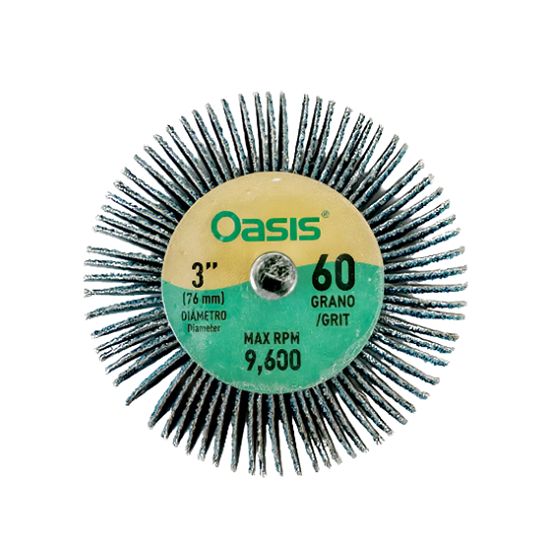
We offer a wide range of flap discs, including the Shaft - mounted Flap Wheel and the Universal Flap Disc. The Shaft - mounted Flap Wheel is ideal for applications where a high - speed, efficient material removal is required. It features a unique design that allows for easy installation and provides excellent performance at high speeds. The Universal Flap Disc, on the other hand, is a versatile option that can be used at a variety of speed settings for different applications.
Conclusion
In conclusion, the speed setting of a variable - speed grinder has a profound impact on the performance of a flap disc. Low - speed settings offer benefits such as a finer surface finish, less heat generation, and slower flap disc wear, while high - speed settings provide increased material removal rates and improved productivity. By understanding the relationship between speed settings and flap disc performance, and by choosing the right flap disc for your application, you can achieve optimal results in your grinding operations.
If you're interested in learning more about our flap discs or need help choosing the right product for your specific needs, I encourage you to reach out to us. We're here to assist you in making the best decision for your grinding requirements and look forward to discussing potential procurement opportunities with you.
References
- Abrasive Engineering Handbook.
- Industrial Grinding and Finishing Techniques.
- Research Papers on Abrasive Tool Performance.