

As a supplier of Universal Flap Discs, I'm often asked about the latest technologies in their production. Universal Flap Discs are versatile abrasives used in various industries, from metal fabrication to woodworking. In this blog, I'll explore the new technologies that are shaping the production of these essential tools.
Advanced Coating Technologies
One of the significant advancements in Universal Flap Disc production is the development of advanced coating technologies. These coatings enhance the performance and durability of the flap discs. For example, some manufacturers are using nanocoatings, which are incredibly thin but provide excellent resistance to wear and corrosion. These nanocoatings can also reduce friction, allowing the flap disc to cut more efficiently and generate less heat.
Another type of coating is the self - lubricating coating. This coating releases lubricants during the grinding process, which helps to prevent the material from loading onto the flap disc. Loading occurs when the abrasive particles become clogged with the material being ground, reducing the disc's effectiveness. By preventing loading, self - lubricating coatings extend the lifespan of the Universal Flap Disc and maintain a consistent cutting performance.
High - Performance Abrasive Grains
The quality of the abrasive grains used in Universal Flap Discs has also seen remarkable improvements. Traditional abrasive grains like aluminum oxide are still widely used, but new high - performance grains are emerging. Cubic boron nitride (CBN) and silicon carbide are two such examples.
Cubic boron nitride is an extremely hard abrasive, second only to diamond in hardness. It has excellent thermal stability and can withstand high temperatures without losing its cutting edge. This makes it ideal for grinding hard metals such as stainless steel and high - alloy steels. Silicon carbide, on the other hand, is known for its sharpness and ability to cut through non - ferrous metals, ceramics, and composites with ease.
Manufacturers are also using a process called grain - sizing optimization. By carefully selecting the size and distribution of the abrasive grains, they can create a more uniform cutting surface. This results in a smoother finish and better control during the grinding process.
Precision Manufacturing Techniques
Precision manufacturing is another area where new technologies are making a difference. Computer - numerical - control (CNC) machining is now commonly used in the production of Universal Flap Discs. CNC machines can precisely cut and shape the flaps, ensuring consistent dimensions and angles. This precision is crucial for achieving a uniform grinding pattern and maximizing the disc's performance.
In addition, automated assembly lines are being used to increase the efficiency of production. These assembly lines can quickly and accurately attach the flaps to the backing plate, reducing the risk of human error. Some assembly lines also use vision systems to inspect the quality of the assembled flap discs, ensuring that only products that meet strict quality standards are sent to market.
Improved Bonding Agents
The bonding agent that holds the abrasive grains to the flaps is also an area of innovation. New bonding agents are being developed that offer better adhesion and heat resistance. Epoxy resins are a popular choice for modern Universal Flap Discs because they provide a strong bond between the abrasive grains and the flaps. They can also withstand high temperatures without breaking down, which is essential for maintaining the integrity of the disc during heavy - duty grinding.
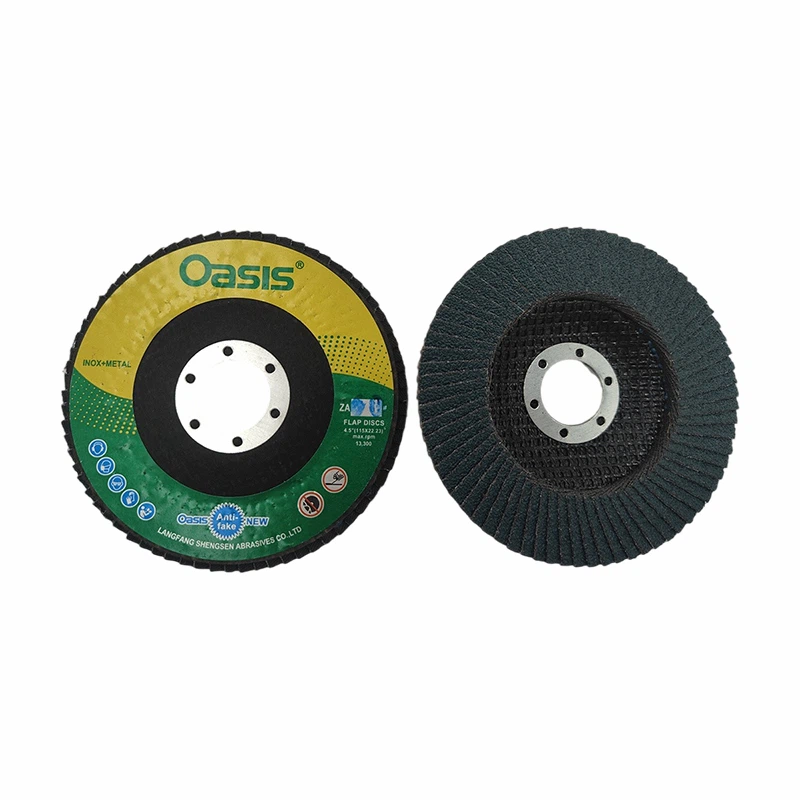

Some bonding agents are also designed to be more flexible, allowing the flaps to conform to the shape of the workpiece. This flexibility can improve the contact between the abrasive and the material, resulting in more efficient grinding and a better finish.
Environmental Considerations
In recent years, there has been a growing emphasis on environmental sustainability in the production of Universal Flap Discs. Manufacturers are looking for ways to reduce the environmental impact of their products. For example, some are using recycled materials in the production of the backing plates and flaps. Recycled plastics and metals can be used to create a more sustainable product without sacrificing performance.
Water - based bonding agents are also becoming more popular. These bonding agents are less toxic than traditional solvent - based ones and produce fewer volatile organic compounds (VOCs) during the manufacturing process. This not only benefits the environment but also improves the working conditions for the employees involved in the production.
The Impact on the Market
These new technologies are having a significant impact on the market for Universal Flap Discs. Customers are increasingly looking for products that offer better performance, longer lifespan, and environmental sustainability. As a supplier, I've noticed that there is a growing demand for flap discs that incorporate the latest technologies.
Customers in industries such as automotive manufacturing, aerospace, and heavy machinery are willing to pay a premium for high - quality Universal Flap Discs that can improve their productivity and reduce downtime. For example, in the aerospace industry, where precision and quality are of utmost importance, the use of advanced flap discs can ensure that critical components are ground to the exact specifications required.
Conclusion
In conclusion, the production of Universal Flap Discs is undergoing a technological revolution. Advanced coating technologies, high - performance abrasive grains, precision manufacturing techniques, improved bonding agents, and environmental considerations are all shaping the future of these essential tools.
As a supplier of Universal Flap Disc, I'm excited to be part of this industry and to offer our customers the latest and greatest products. If you're in the market for Universal Flap Discs and want to learn more about how our technologically advanced products can benefit your business, I encourage you to contact us for a procurement discussion. We're always happy to share our knowledge and expertise and to help you find the right solution for your specific needs.
References
- "Advanced Abrasive Technologies for Industrial Applications" - Journal of Materials Processing Technology
- "Sustainable Manufacturing in the Abrasive Industry" - International Journal of Environmental Science and Technology
- "Precision Manufacturing of Abrasive Tools" - Manufacturing Engineering Magazine