

Hey there! As a supplier of stone cutting wheels, I often get asked, "How do I choose the right grit for a stone cutting wheel?" It's a crucial question because picking the wrong grit can lead to inefficient cutting, poor results, and even damage to your equipment. So, let's dive into this topic and break it down in a way that's easy to understand.
What is Grit?
First things first, let's talk about what grit actually means. Grit refers to the size of the abrasive particles on the cutting wheel. It's usually measured by a number, and the higher the number, the smaller the abrasive particles. For example, a wheel with a grit of 24 has larger abrasive particles than a wheel with a grit of 120.
Coarse Grit (16 - 36)
Coarse grit wheels are like the heavy - hitters in the world of stone cutting. They have large abrasive particles that are great for making quick cuts through thick or hard stones. If you're working on a big project where you need to remove a lot of material fast, a coarse grit wheel is your best bet.
For instance, if you're cutting large blocks of granite or marble for construction purposes, a wheel with a grit between 16 - 36 will do the job efficiently. These wheels can take on tough jobs and make short work of thick stones. However, the downside is that they tend to leave a rougher finish. So, if you're looking for a smooth surface, you'll need to do some additional finishing work after using a coarse grit wheel.
You can check out our Universal Cutting Disc which comes in different grits, including coarse ones, suitable for various stone cutting tasks.
Medium Grit (40 - 80)
Medium grit wheels are a great all - around option. They offer a good balance between cutting speed and finish quality. If you're not in a huge rush to remove material but still want to get the job done relatively quickly, a medium grit wheel is ideal.
These wheels are perfect for projects where you need to make precise cuts and also want a reasonably smooth finish. For example, if you're cutting stone for countertops or decorative pieces, a medium grit wheel can give you the right combination of efficiency and quality. You won't have to spend as much time on finishing as you would with a coarse grit wheel, but you'll still get a decent cutting speed.
Our Alloy&stone Cutting Disc is available in medium grits and can handle both alloy and stone cutting, making it a versatile choice for your workshop.
Fine Grit (100 - 220)
Fine grit wheels are all about the finish. They have very small abrasive particles that are used to create a smooth and polished surface on the stone. If you're working on a project where the appearance of the stone is of utmost importance, like creating detailed sculptures or high - end architectural elements, a fine grit wheel is what you need.
However, fine grit wheels are not the best for removing large amounts of material quickly. They work best as a final step in the cutting process after you've used a coarser wheel to do the bulk of the cutting. Using a fine grit wheel from the start would be extremely time - consuming and inefficient.
Ultra - Fine Grit (240+)
Ultra - fine grit wheels are used for the most delicate and high - end finishing work. They can create an almost mirror - like finish on the stone. These wheels are typically used in the jewelry industry or for extremely detailed and high - quality stonework.
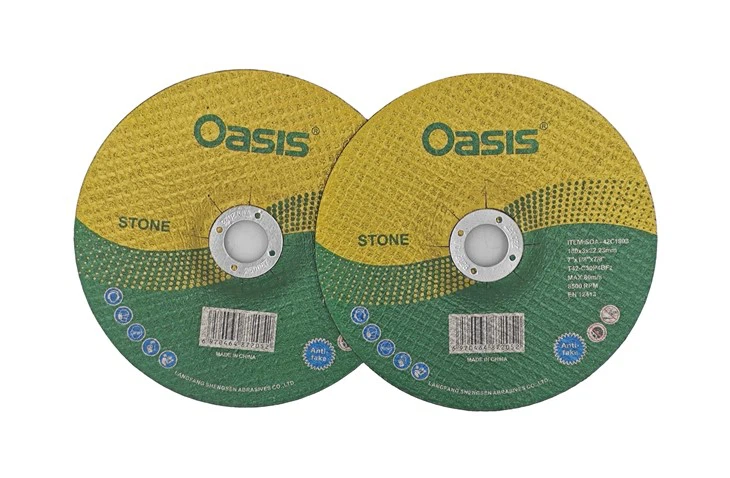

But keep in mind, working with ultra - fine grit wheels requires a lot of patience and skill. They are very slow at removing material, and you need to use them carefully to avoid over - polishing or damaging the stone.
Other Factors to Consider
Choosing the right grit isn't just about the type of project you're working on. There are other factors that can influence your decision.
The hardness of the stone is a major factor. Harder stones like granite will require a coarser grit to make efficient cuts, while softer stones like limestone can often be cut with a finer grit. Also, the type of cutting machine you're using matters. Some machines are more powerful and can handle coarser grit wheels better, while others may require a finer grit for optimal performance.
The speed at which you're cutting also plays a role. If you're cutting at a high speed, a coarser grit may be more suitable to prevent overheating and damage to the wheel. On the other hand, if you're cutting at a slower speed, you can use a finer grit for a better finish.
Rail Cutting Discs
If you're specifically involved in rail cutting, our Rail Cutting Disc is a great option. Rail cutting often requires a specific type of cutting wheel due to the unique properties of rails. These discs are designed to handle the tough and dense material of rails efficiently. They usually come in a medium to coarse grit range to ensure fast and effective cutting.
Conclusion
In conclusion, choosing the right grit for a stone cutting wheel depends on several factors, including the type of project, the hardness of the stone, the cutting machine, and the cutting speed. Coarse grits are great for fast material removal, medium grits offer a good balance, fine grits are for finishing, and ultra - fine grits are for the most delicate work.
If you're still not sure which grit is right for your specific needs, don't hesitate to reach out. We're here to help you make the best choice for your stone cutting projects. Whether you're a professional contractor, a DIY enthusiast, or someone in the jewelry industry, we have the right cutting wheels for you. Contact us to start a procurement discussion and find the perfect stone cutting wheel for your requirements.
References
- Norton Abrasives Handbook: A comprehensive guide on abrasive products and their applications.
- Stone Cutting Industry Best Practices Manual: Offers insights into the latest techniques and product selection in stone cutting.