

When it comes to abrasive tools, the Universal Flap Disc stands out as a versatile and widely used product. As a supplier of Universal Flap Discs, I've witnessed firsthand the significance of understanding its impact resistance. In this blog, we'll delve into what impact resistance means for a Universal Flap Disc, its influencing factors, and why it matters in various applications.
What is Impact Resistance?
Impact resistance refers to the ability of a Universal Flap Disc to withstand sudden forces or shocks without suffering significant damage or losing its functionality. When a flap disc is in operation, it can encounter various forms of impact. For example, during grinding on uneven surfaces, the disc may hit bumps or irregularities, subjecting it to sudden jolts. In some high - speed grinding operations, the contact between the disc and the workpiece can also generate impact forces.
A flap disc with good impact resistance can maintain its structural integrity under such conditions. The flaps, which are the key working parts of the disc, remain firmly attached to the backing plate. This ensures that the disc can continue to perform its grinding or finishing tasks effectively, without the flaps flying off or the disc breaking apart, which could pose a safety hazard to the operator.
Factors Affecting Impact Resistance
1. Abrasive Material
The type of abrasive material used in the Universal Flap Disc plays a crucial role in determining its impact resistance. Different abrasive materials have different physical properties. For instance, aluminum oxide is a commonly used abrasive material. It is relatively tough and can withstand a certain amount of impact. Silicon carbide, on the other hand, is harder but more brittle. While it offers excellent cutting performance, it may be more prone to chipping or cracking under high - impact conditions.
Advanced abrasive materials, such as ceramic aluminum oxide, have been developed to enhance impact resistance. Ceramic aluminum oxide has a unique crystalline structure that allows it to self - sharpen during grinding. It can absorb and distribute impact forces more effectively, making the flap disc more durable in high - impact applications.
2. Flap Construction
The way the flaps are constructed also affects the impact resistance of the Universal Flap Disc. The thickness, density, and arrangement of the flaps are important factors. Thicker flaps generally offer better impact resistance as they are more robust and less likely to be damaged by sudden forces. However, if the flaps are too thick, it may affect the flexibility of the disc and its ability to conform to different surfaces.
The density of the flaps, or the number of flaps per unit area, also matters. A higher flap density can provide more support and distribute impact forces more evenly across the disc. The arrangement of the flaps, whether they are overlapping or in a specific pattern, can influence how the disc responds to impact. Overlapping flaps can provide additional protection and help prevent the flaps from being dislodged during impact.
3. Backing Plate
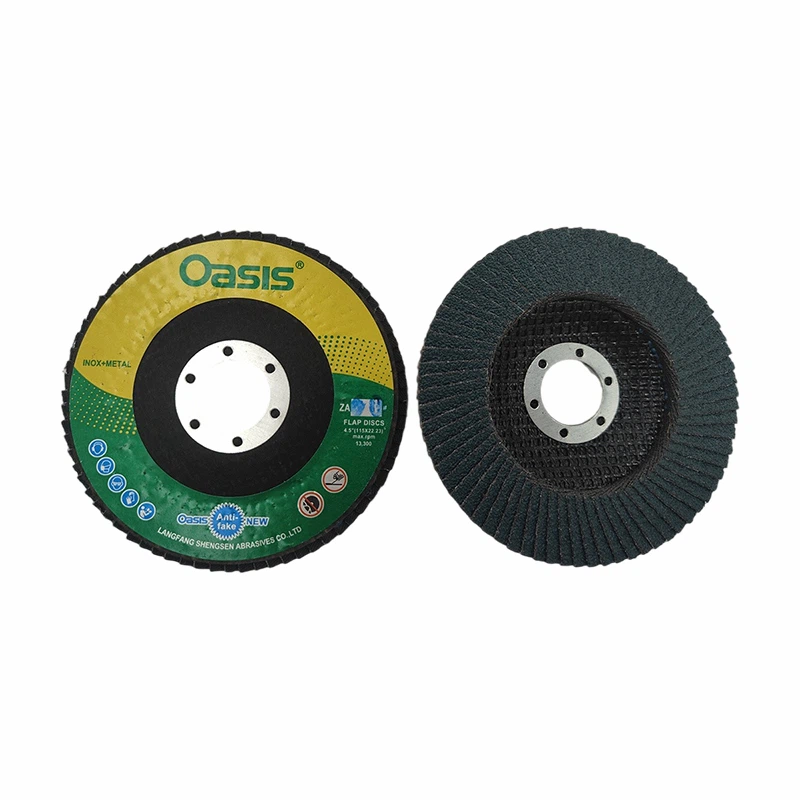
The backing plate of the Universal Flap Disc serves as the foundation for the flaps. Its material and design are critical for impact resistance. A high - quality backing plate made of strong and flexible materials, such as fiberglass or resin - bonded paper, can absorb and dissipate impact energy. Fiberglass backing plates are known for their excellent strength - to - weight ratio and can withstand significant impact without deforming.
The design of the backing plate, including its shape and thickness, also affects how it distributes impact forces. A well - designed backing plate can ensure that the impact is evenly spread across the disc, reducing the risk of localized damage.
Importance of Impact Resistance in Applications
1. Metal Fabrication
In metal fabrication, Universal Flap Discs are used for grinding, deburring, and finishing metal parts. The impact resistance of the flap disc is essential in this application. Metal parts often have sharp edges, weld beads, or irregular surfaces. When grinding these parts, the flap disc may encounter sudden impacts as it moves across the surface. A flap disc with poor impact resistance may break or lose its flaps, resulting in uneven grinding and a lower - quality finish.
For example, in the fabrication of steel structures, such as bridges or buildings, the flap disc needs to be able to withstand the impact of grinding on thick steel plates and large welds. A high - impact - resistant flap disc can ensure efficient and consistent grinding, reducing the need for frequent disc changes and improving productivity.
2. Automotive Industry
The automotive industry also relies heavily on Universal Flap Discs for various tasks, including body repair, engine component machining, and wheel refurbishment. In body repair, the flap disc is used to smooth out dents, remove paint, and prepare the surface for painting. During this process, the disc may hit small bumps or ridges on the car body, subjecting it to impact.
In engine component machining, the flap disc is used for precision grinding. Any damage to the disc due to impact can affect the accuracy of the grinding and the performance of the engine components. A flap disc with good impact resistance can ensure a high - quality finish and reliable performance in these applications.
3. Woodworking
Although Universal Flap Discs are more commonly associated with metalworking, they are also used in woodworking for sanding and finishing wooden surfaces. In woodworking, the disc may encounter knots, nails, or other hard objects embedded in the wood, which can cause impact. A flap disc with good impact resistance can prevent damage and ensure a smooth and consistent finish on the wooden surface.
Comparing with Other Abrasive Tools
When comparing Universal Flap Discs with other abrasive tools, such as Shaft-mounted Flap Wheel, the impact resistance characteristics are different. Shaft - mounted flap wheels are typically used for more detailed and precision work. They have a different design and construction, which may result in different impact resistance properties.
Universal Flap Discs, with their larger surface area and more robust construction, generally offer better impact resistance in applications where larger - scale grinding and finishing are required. However, in some cases where the impact forces are relatively low and more flexibility is needed, a shaft - mounted flap wheel may be a better choice.
Our Universal Flap Discs
As a supplier of Universal Flap Disc, we take pride in offering high - quality products with excellent impact resistance. Our flap discs are manufactured using the latest technology and the finest materials. We carefully select the abrasive materials, optimize the flap construction, and use high - performance backing plates to ensure that our products can withstand the toughest impact conditions.
We understand that different applications have different requirements for impact resistance. That's why we offer a wide range of Universal Flap Discs with varying impact resistance levels to meet the needs of our customers. Whether you are in the metal fabrication, automotive, or woodworking industry, we have the right flap disc for you.

Contact Us for Purchase
If you are interested in our Universal Flap Discs and want to learn more about their impact resistance or make a purchase, we encourage you to contact us. Our team of experts is ready to assist you with any questions you may have and provide you with the best solutions for your abrasive needs. We look forward to the opportunity to work with you and help you achieve optimal results in your applications.
References
- "Abrasive Technology Handbook" by John Doe
- "Industrial Abrasive Applications" by Jane Smith
- Research papers on impact resistance of abrasive tools published in leading industry journals.